
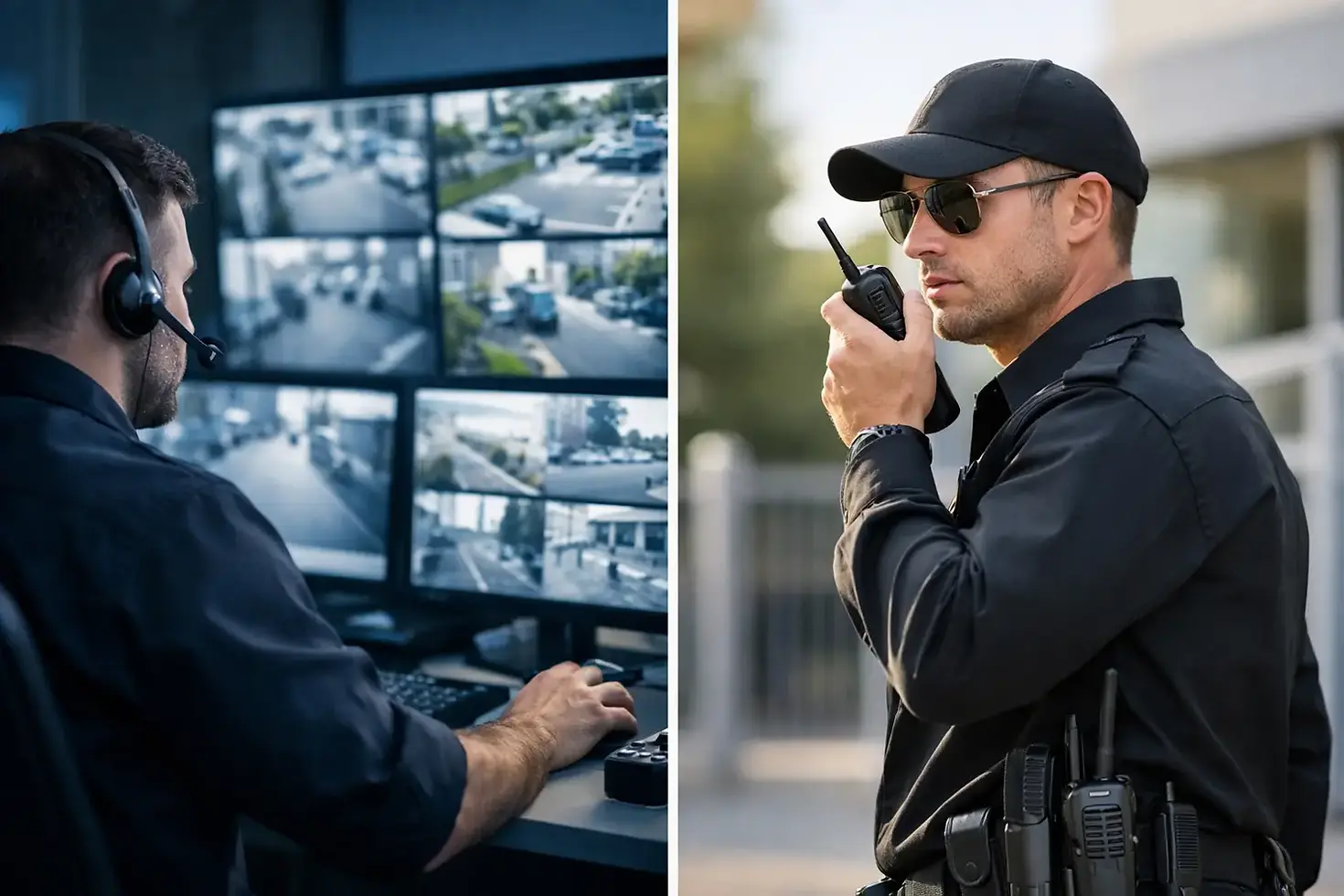
Live Monitoring vs Security Guards
A stolen skid steer at 2:13 a.m. does not wait for office hours. Neither does a gate breach at a storage yard or a person testing door handles behind a retail plaza. When property owners compare live monitoring vs security guards, they are usually not debating theory. They are trying to prevent loss, avoid downtime, and make sure someone responds before a bad situation gets worse.
For many sites, the real question is not which option sounds more traditional. It is which one gives better coverage, faster detection, and a more practical return on security spend. The answer depends on the type of property, the hours of risk, and how much activity needs to be watched at once.
Live monitoring vs security guards: what changes on the ground?
A security guard is a physical presence on site. That can be valuable. Guards can walk a property, speak with visitors, lock or unlock areas, and act as a visible deterrent. On the right site, that presence matters.
Live monitoring works differently. Cameras, analytics, and trained monitoring personnel watch the property in real time and respond when something unusual happens. Instead of waiting for someone to discover damage after the fact, live monitoring is built to identify suspicious activity while it is happening and trigger intervention quickly.
That difference matters because many incidents are short. Trespassers do not always stay long. Theft can happen in minutes. Vandalism can happen even faster. If your security model relies on someone being in exactly the right place at the right moment, there is always a coverage gap.
With live video monitoring, multiple areas can be watched at the same time, including blind spots that a patrol route may only pass every 20 or 30 minutes. For large properties or sites with irregular layouts, that changes the odds in your favor.
Cost is usually the first pressure point
For most business owners and property managers, cost is where the comparison starts. A single guard on one shift is one expense. Round-the-clock coverage is another. Once you factor in nights, weekends, holidays, relief staff, supervision, and turnover, manned guarding can become one of the largest recurring costs in a security budget.
Live monitoring often delivers broader coverage at a lower monthly cost, especially for construction sites, dealerships, storage facilities, vacant buildings, and multi-tenant commercial properties. One monitored camera system can watch entry points, fence lines, parking areas, loading zones, and equipment storage without requiring a person to physically move between them.
That does not mean guards are never worth the spend. If your property needs concierge-style access control, visitor management, or someone to physically inspect interiors throughout the day, a guard may still be the right fit. But if the core goal is to detect intrusions, discourage theft, and get a rapid response after hours, live monitoring is often the more efficient option.
Coverage and consistency are where the gap gets wider
People get tired. Patrol routes vary. Attention drifts. Even strong guard teams have human limits, especially on overnight shifts or in extreme weather. Security guards are also restricted by what they can physically see from one location at one time.
Live monitored systems do not have that same limitation. Cameras stay fixed on critical zones, and monitoring personnel can review multiple views at once. Activity at a rear fence does not make the front gate disappear. A vehicle entering one side of the property does not pull attention away from a pedestrian approaching another access point.
This is especially important for properties with broad footprints or multiple risk points. Construction sites are a clear example. Materials, tools, fuel, copper, and heavy equipment are often spread across large areas, and the site changes weekly. A single guard cannot stand everywhere at once. A properly designed live monitoring setup can.
Response time is not the same as presence
A common argument for security guards is simple: if someone is already on site, response should be faster. Sometimes that is true. But presence and effective response are not always the same thing.
If a guard is on the far side of the property, checking a mechanical room, or tied up with another issue, they may not see an incident begin. A monitored system can detect motion or suspicious behavior immediately, verify it through live video, issue audio warnings where appropriate, and escalate to law enforcement or designated contacts without delay.
That layered response is often more useful than a single person walking patrol. The goal is not just to have someone somewhere on the property. The goal is to identify the threat early enough to interrupt it.
For many clients, that is the turning point in the live monitoring vs security guards discussion. They stop asking which option looks more secure and start asking which one catches problems faster.
Deterrence works in different ways
Guards deter by being seen. There is real value in that. An occupied gatehouse or visible patrol vehicle sends a message that the property is being watched.
Live monitoring deters differently. Clearly placed cameras, active monitoring signage, speaker warnings, and rapid intervention create uncertainty for trespassers and thieves. They no longer assume they have time to move around unnoticed. If someone hears a live voice address them by location and tell them police have been notified, the situation changes immediately.
That kind of intervention is especially effective after hours, when many crimes happen because offenders believe no one is watching in real time. Passive cameras may record the event. Live monitoring can help stop it before the loss is done.
When security guards still make sense
This is not an all-or-nothing decision. There are properties where guards remain a necessary part of the plan. High-traffic commercial buildings, sites with frequent deliveries, facilities with public-facing access points, and locations that require onsite customer interaction may benefit from a guard presence during business hours.
There are also situations where a temporary guard is useful, such as after a break-in, during a shutdown, or while a site is under construction and still being configured. In those cases, a guard can provide immediate short-term coverage while a long-term monitoring strategy is put in place.
The strongest security plans are often built around the actual risk, not around habit. If a site needs an onsite person for operational reasons, that is one thing. If it only needs strong after-hours protection, live monitoring may solve the real problem more directly.
The best answer is often a layered approach
For some properties, live monitoring vs security guards is not a winner-takes-all choice. A hybrid model can be the most practical answer. A guard might cover daytime access control or scheduled patrols, while live monitoring protects the property overnight, on weekends, and during periods when risk is highest.
This approach often reduces cost without reducing protection. It also gives property owners better visibility into what is actually happening. Video verification helps separate real threats from routine activity, which can reduce false alarms and improve response decisions.
That matters for busy site operators who do not want to be called for every minor alert. They want meaningful information, confirmed activity, and a clear action plan when something needs attention.
Choosing the right fit for your property
The right solution depends on a few practical questions. Is your property large or spread out? Does most of the risk happen after hours? Are theft, trespassing, and vandalism your main concerns? Do you need physical visitor assistance, or do you mainly need rapid threat detection and response?
If your main issue is protecting assets across a broad site, live monitoring usually has the advantage. If you need someone onsite to manage people, check credentials, or support daily operations, a guard may still be part of the answer. If you need both, build both, but do it intentionally.
For businesses and homeowners who are tired of reactive security, the shift toward monitored protection is not just about technology. It is about getting ahead of incidents instead of reviewing them later on video. That is why many Manitoba property owners are moving toward local, active monitoring backed by real people who can respond when it counts. At Guardian Advanced Solutions, that is the standard we believe security should meet.
Security should match the way risk actually shows up on your property, not the way it looked ten years ago.


Comments